
Precision Grinding Services

Precision grinding for tight-tolerance parts and high-quality surface finishes. Service availability depends on material, geometry, and inspection requirements.

Start A New Precision Grinding Quote

All uploads are secure and confidential.

 Xometry’s Instant Quoting Engine is covered by U.S. Pat. Nos. 11,086,292, 11,347,201, 11,693,388, 11,698,623, 12,099,341, and 12,189,361. Other patents pending.

Precision grinding is a finishing process that uses abrasives to remove very small amounts of material to achieve accurate dimensions and smooth surface finishes. It’s often selected when machining alone can’t reliably meet flatness, roundness, or surface finish requirements, or when parts are hardened and difficult to cut efficiently with standard tools.

LK Tools supports multiple precision grinding methods depending on your geometry and functional requirements.

What Is Precision Grinding?

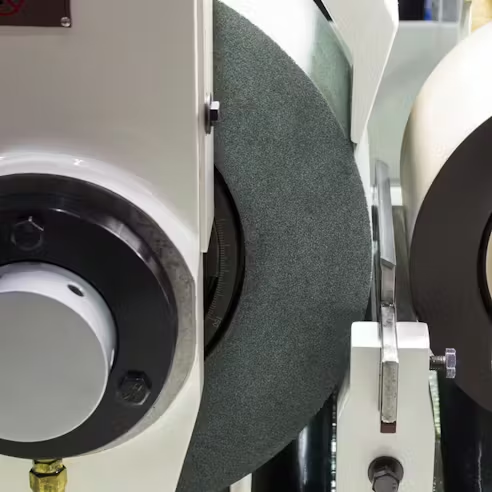
Precision grinding removes material using a rotating abrasive wheel or belt. Because it can remove extremely small amounts of stock in a controlled way, it’s commonly used as a final step to meet demanding tolerances and finish requirements.

Grinding can be used as:

  • final finishing process for critical surfaces
  • A step to prepare parts for other finishing processes such as honing, lapping, or superfinishing

Abrasive selection depends on the workpiece material. Common abrasive families include aluminum oxide, silicon carbide, and diamond (application-dependent). CNC-controlled grinding typically provides the most consistent results for production parts.

Types of Precision Grinding

LK Tools can support several common precision grinding methods:

  • Cylindrical Grinding
  • Centerless Grinding
  • Internal Grinding​
  • Spindle Grinding​

1. Cylindrical Grinding

Used to grind the outside diameter (OD) of round parts. The workpiece rotates while the grinding wheel removes material from the external surface, producing accurate diameters and good finishes.

2. Centerless Grinding

A high-throughput method for OD grinding where the part is supported between a grinding wheel and a regulating wheel—without holding the part between centers. Often selected for shafts, pins, and high-volume round parts.

3. Internal Grinding

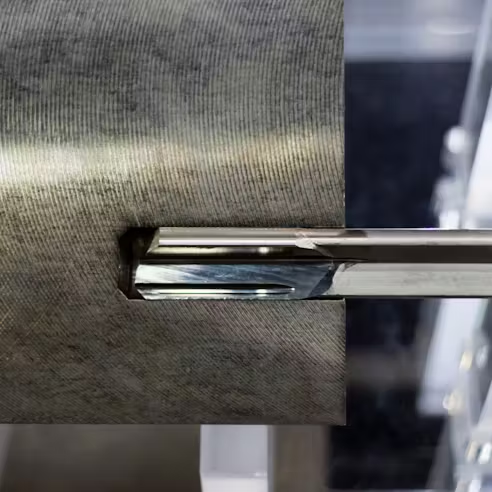
Used to grind internal bores/IDs. The grinding tool is sized for the bore and removes stock to achieve accurate internal diameters, roundness, and surface finish.

4. Spindle (Surface) Grinding

Often used for flat parts and planar surfaces. Depending on setup (vertical or horizontal spindle), it can grind flat faces, angles, tapers, and slots (project-dependent).

Benefits of Precision Grinding

Precision grinding benefits are listed and described below:

  • Cost-Effectiveness​
  • Accuracy​
  • Reliable
  • Tight Tolerances
  • Smooth Surface Finishes

1. Cost-Effectiveness

Precision grinding is a cost-effective process because of its ability to achieve precise dimensions in large volumes of parts. Not only is the process fast, but it’s also versatile and highly reliable. Precision grinding can be used on a wide array of materials, including hardened steel and non-ferrous metals, and seldom produces non-conforming parts. 

2. Accuracy

A high degree of accuracy is a huge advantage of precision grinding. In manufacturing, machining processes like milling and turning are used to achieve dimensions close to what is required. While required dimensions can often be achieved with these machining processes, grinding enables manufacturers to remove tiny amounts of material to create extremely accurate parts.

3. Reliable

Precision grinding is a highly reliable process. Defects seldom occur during grinding processes, since the process is easy to set up, highly efficient, and applies less pressure to the workpiece than other processes used to obtain precise dimensions like machining. 

4. Tight Tolerances

Tight tolerances are another advantage of precision grinding. With precision grinding, We can achieve tolerances as tight as +0.00025”. Tolerances this low are great for parts commonly manufactured for the automotive, aerospace, and medical industries. Especially in the medical industry where parts are fitted to or implanted into a person’s body, precise parts are absolutely essential. 

5. Smooth Surface Finishes

Precision grinding produces very smooth surface finishes. This is important not just for functionality, such as in medical parts like surgical instruments, but also for the aesthetic qualities of the finished product.

Drawbacks of Precision Grinding

Precision grinding is not without its disadvantages. Some disadvantages of the process are listed below:

  • Time-Consuming​
  • High Initial Investment​
  • Could Contaminate Parts​

1. Time-Consuming

Grinding can add cycle time and cost—especially when extremely tight tolerances or cosmetic finishes are required.

2. High Initial Investment

Grinding equipment and setup can be expensive, which is why it’s typically used where the value of precision justifies the process.

3. Could Contaminate Parts

Grinding can leave fine debris from abrasives or removed material. For high-cleanliness applications, cleaning and handling requirements should be specified.

In need of custom precision grinding services?

Industries Using Precision Grinding

Precision grinding is common wherever accurate fits and smooth surfaces are required. Examples include:

  • Automotive​
  • Aviation​
  • Bearing
  • Electrical​
  • Medical​

1. Automotive

Used for shafts, gears, bearing surfaces, and drivetrain components where fit and finish affect performance.

2. Aviation

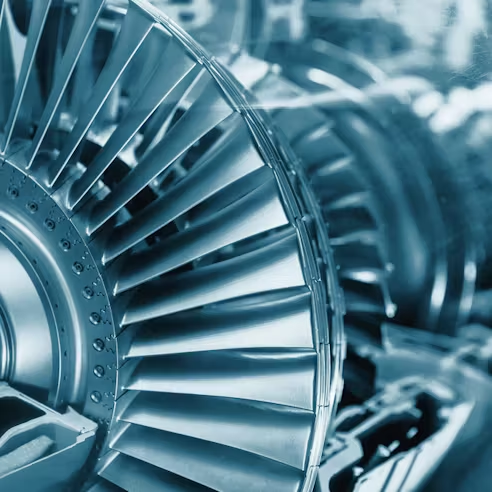
Used for landing gear components, bearing surfaces, and turbine-related parts where precision matters.

3. Bearing

Bearings require tight fits and surface finish control. Grinding is frequently used for races and mating components.

4. Electrical

Used for motor components, heat sinks, and parts that must fit precisely into compact assemblies.

5. Medical

Used for instruments and components where surface finish and dimensional control are important; requirements vary widely by program.

Alternatives to Precision Grinding

If grinding isn’t the best fit, alternatives may include:

  • Reaming​
  • Honing​
  • Lapping

1. Reaming

Used to size and finish internal holes/bores accurately (limited to internal features).

2. Honing

Uses abrasives to improve bore geometry and finish; often selected for roundness/straightness control in holes.

3. Lapping

Uses abrasive slurry to achieve very fine finishes and extremely small stock removal; excellent for high-precision flatness or fit requirements (project-dependent).

Why Choose LK Tools For Precision Grinding Services?

Endless Options

Choose from millions of possible combinations of materials, finishes, tolerances, markings, and certifications for your order.

Easy to Use

Get started with our easy-to-use platform and let our experts take care of managing the project from locating the right manufacturing partner to delivery logistics.

Vetted Network

We are ISO 9001:2015, ISO 13485, and AS9100D certified. Only the top shops that apply to become suppliers make it through our qualification process.

Ready To Start Your Precision Grinding Quote?

We make it fast, easy, and risk-free to get started.
Get Free Quote in 30 Minutes

All uploads are secure and confidential

Samples in 1 day, $50-200 fee refunded on 100+ units
Get a Quote in 30 Minutes
All uploads are secure and confidential.