
CNC Routing Services

Fast, accurate CNC routing for plastics, composites, and sheet materials. LK Tools supports prototypes and low-volume production with consistent cut quality, practical engineering guidance, and scalable manufacturing support.

Start A New CNC Routing Quote

STEP | STP | SLDPRT | IPT | PRT | SAT files

All uploads are secure and confidential.

 Xometry’s Instant Quoting Engine is covered by U.S. Pat. Nos. 11,086,292, 11,347,201, 11,693,388, 11,698,623, 12,099,341, and 12,189,361. Other patents pending.

CNC routing is an efficient way to cut and machine sheet-based parts with clean edges and repeatable geometry. It’s commonly used for plastic panels, enclosures, brackets, fixtures, insulation components, and composite parts where profile accuracy and consistent cut quality matter.

LK Tools can support routing projects from early prototypes through repeat low-volume runs. If your part has tight fit requirements or needs a specific edge quality, share those details in your RFQ—our engineers can recommend tooling, cut strategy, and finishing options.

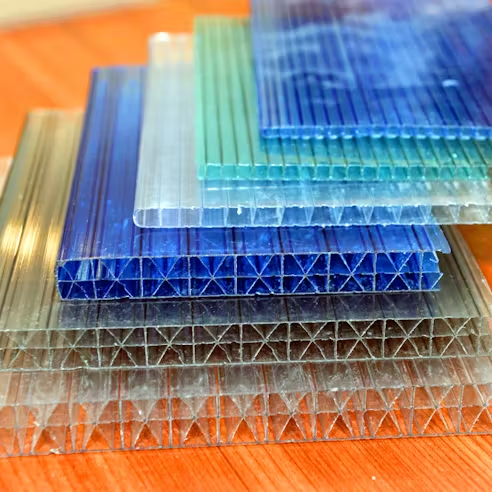
Our CNC routing services cover a wide range of materials, including MDF (medium-density fiberboard), plywood, acrylic, polyurethane foam, and polyethylene sheet, as well as softer metals like brass, aluminum, and occasionally steel.

What Is CNC Routing?

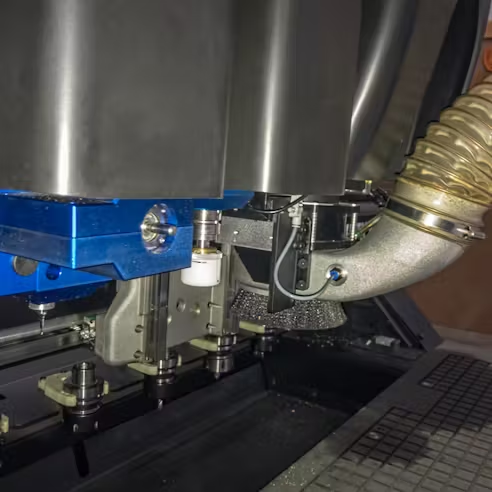
CNC routing is a subtractive manufacturing process that uses a high-speed spindle and cutting tools to cut profiles, pockets, slots, and holes—most often in sheet materials. Unlike typical CNC milling (often used for thicker blocks), routing is optimized for panels and flat stock, making it a practical solution for larger parts and faster throughput.

Depending on geometry and material, routing can include drilling, countersinking, engraving, and pocketing. LK Tools can also advise on best practices for tabs, fixturing, edge protection, and part nesting to control cost and lead time.

Advantages of CNC Routing

When fixturing and material stability are controlled, CNC routing can achieve consistent dimensions for profiles, hole patterns, and assembly features. Share your critical dimensions and we’ll confirm feasibility during quoting.

Tight Tolerances

When fixturing and material stability are controlled, CNC routing can achieve consistent dimensions for profiles, hole patterns, and assembly features. Share your critical dimensions and we’ll confirm feasibility during quoting.

Flexibility

Routing supports fast design changes—perfect for prototypes and iterative development without tooling changes.

Reproducibility

Once your program is dialed in, routing provides repeatable part geometry for ongoing low-volume or batch production.

Complex Shapes and Intricate Designs

Profiles, pockets, engraved details, and cutouts are straightforward—especially for panel parts and enclosures.

Common Materials for CNC Routing

CNC routers are compatible with a wide range of materials, including: soft metals, wood, plastics, and composites. Below is a list of some of the most common materials used in CNC routing:

The best routing outcome comes from matching tool selection and cutting parameters to the material and part geometry. Factors like wall thickness, small internal radii, deep pockets, and high cosmetic expectations can influence toolpath strategy and cycle time.

To keep parts consistent and cost-effective, LK Tools can advise on:

  • Minimum internal corner radii (based on tool diameter)
  • Part nesting strategy for better material utilization
  • Tabs/bridges to hold parts securely during cutting
  • Edge quality targets and deburring requirements
  • Hole quality expectations (especially for thin panels)

If you have assembly mating features or tight hole-to-hole spacing, include a 2D drawing so we can prioritize inspection and control where it matters most.

In need of custom CNC routing services?

Applications of CNC Routing

CNC routing is commonly used for panel and sheet components across many industries.

  • Plastic covers, panels, and faceplates
  • Enclosures and equipment housings (sheet-based)
  • Brackets and mounting plates
  • Insulation and spacer components
  • Fixtures, templates, and gauges
  • Automotive interior trim prototypes (project-dependent)
  • Robotics and automation panels and guards

CNC Routing Process

The following steps are used to turn your designs into a finished product through CNC routing:

  1. Upload CAD + drawings and define critical dimensions
  2. Engineering review for material, tooling, and fixturing strategy
  3. Routing + edge control (tabs, deburr, cosmetic handling)
  4. Inspection (as required—dimensional report/FAI upon request)
  5. Packaging and delivery

How Do We Account for Kerf?

Kerf is the amount of material removed by the cutting tool. In CNC routing, kerf is primarily determined by tool diameter and toolpath strategy. Correct kerf compensation ensures the finished part matches the intended profile and hole sizes.


LK Tools programs toolpaths with proper cutter compensation and validates results through first-part checks. For tight-profile tolerances or critical hole patterns, we may recommend test cuts or measurement checkpoints to confirm the process before running the full batch.

Why Choose LK Tools for CNC Routing Services?

Endless Options

Choose from millions of possible combinations of materials, finishes, tolerances, markings, and certifications for your order.

Easy to Use

Get started with our easy-to-use platform and let our experts take care of managing the project from locating the right manufacturing partner to delivery logistics.

Vetted Network

We are ISO 9001:2015, ISO 13485, IATF 16949:2016, and AS9100D certified. Only the top shops that apply to become Suppliers make it through our qualification process.

Ready to use CNC Routing Services for production components?

We make it fast, easy, and risk-free to get started.
Get Free Quote in 30 Minutes

All uploads are secure and confidential

Samples in 1 day, $50-200 fee refunded on 100+ units
Get a Quote in 30 Minutes
All uploads are secure and confidential.