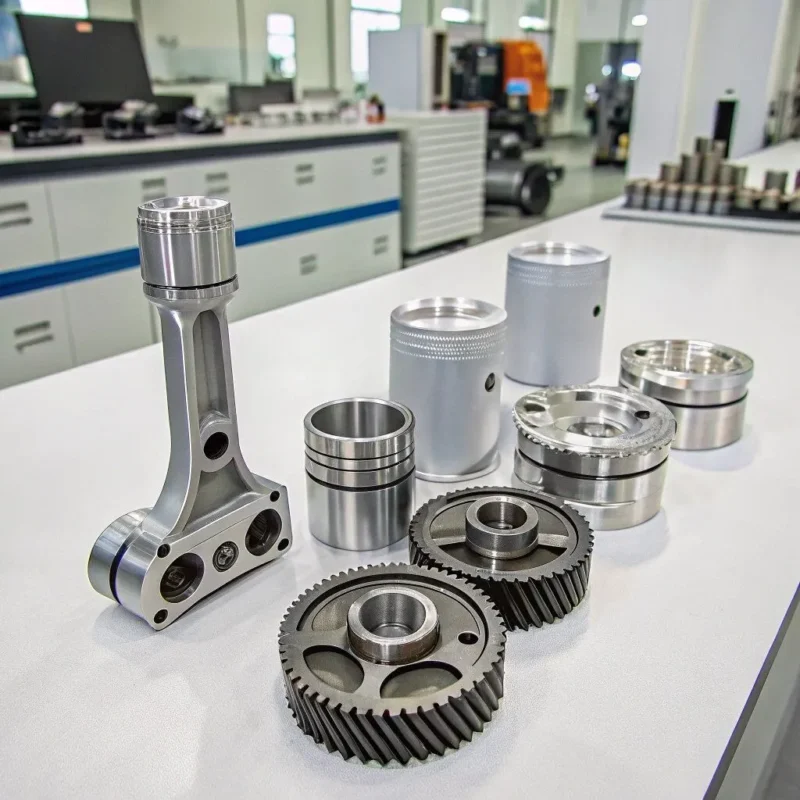
Welding — Laser, TIG, MIG/GMAW & Friction Stir Welding (FSW)
Comprehensive welding capabilities for production and prototype work: high‑precision laser welding, TIG and MIG fusion welding, and solid‑state friction stir welding (FSW). We combine process selection, custom fixturing, robotic integration and NDT to deliver repeatable, qualified joints for thermal assemblies, structural components and leak‑tight enclosures.
Quick Capabilities
Robotic & manual laser cells • FSW gantries for cold plate sealing • TIG/MIG stations for alloys & filler metal control • Weld sensors, seam tracking, leak test & NDT.
Welding Methods & Where They're Best
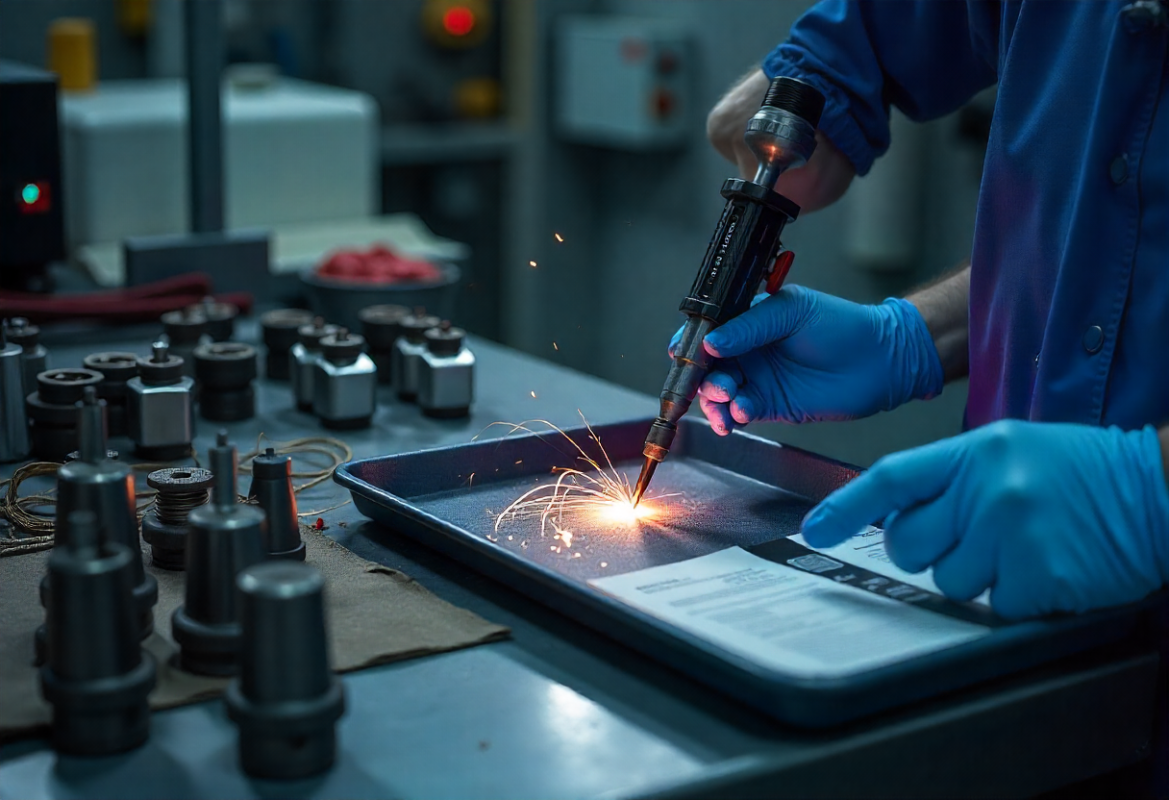
Laser Welding
Low heat input, narrow HAZ, minimal distortion and excellent cosmetic finish — fiber and disk lasers for thin to medium sections; suitable for stainless, aluminum (with process control), and precision assemblies.
TIG (GTAW)
Flexible for large, low‑to‑medium voluHigh control, low spatter, ideal for critical joints, thin sections and where filler selection is important (aerospace/medical/food‑grade welds).mes; cost effective for large sections and rapid pattern changes.
MIG / GMAW
High deposition rates for thicker sections and production welding; pulse MIG options reduce heat input and improve control on thin materials.
Friction Stir Welding (FSW)
Solid‑state process yielding low porosity and excellent mechanical properties in aluminum and some copper alloys — used for cold plates, pressure vessels and structural seams.
Brazing & Soldering
For dissimilar metals, thin joining or where base metal heating must be minimized — controlled metallurgy and flux/atmosphere are used for reliable joints.
Materials, Joint Types
Material selection and metallurgy drive the weld process. Aluminum, stainless, carbon steels, copper/brass, titanium and plated surfaces each require tailored processes, shielding, filler selection and pre/post‑weld treatment to control distortion, corrosion and joint properties.
Common joint types
- Butt, lap & edge joints for sheet and plate assemblies
- Seam welds for cold plates (FSW or laser)
- Fillet welds for structural brackets and frames
- Brazed joints for heat‑sensitive or dissimilar metal connections


Fixture Design, Robotic Cells
Fixtures control part datum, clamping, reaction forces and thermal sinks. We design custom fixtures for FSW torque reaction, laser access and seam guidance, and integrate palletized quick‑change systems, vision guidance and seam tracking for robotic welding cells.
Fixture features
- Kinematic datums and repeatable pallet interfaces
- Active cooling channels for thermal control during welding
- Torque reaction and sacrificial backing plates for FSW
- Masking, shielding gas manifolds and optical sight windows for laser
Process Control, Validation & Qualification
We document process windows (power, travel speed, defocus, shielding, filler feed, spindle load for FSW), conduct capability studies (Cpk), and provide qualification packages with FAI, weld procedure spec (WPS) and operator training for production release.
| Deliverable | Purpose | Typical Contents |
|---|---|---|
| WPS / PQR | Define and record qualified welding parameters | Machine settings, filler, shielding, pre/post treatments, inspection criteria |
| FAI / Qualification | Production release verification | Sample welds, NDT, mechanical tests, process window and SPC |
| Capability studies | Confirm process stability | Cp/Cpk, control charts and reject logic |
Inspection & NDT
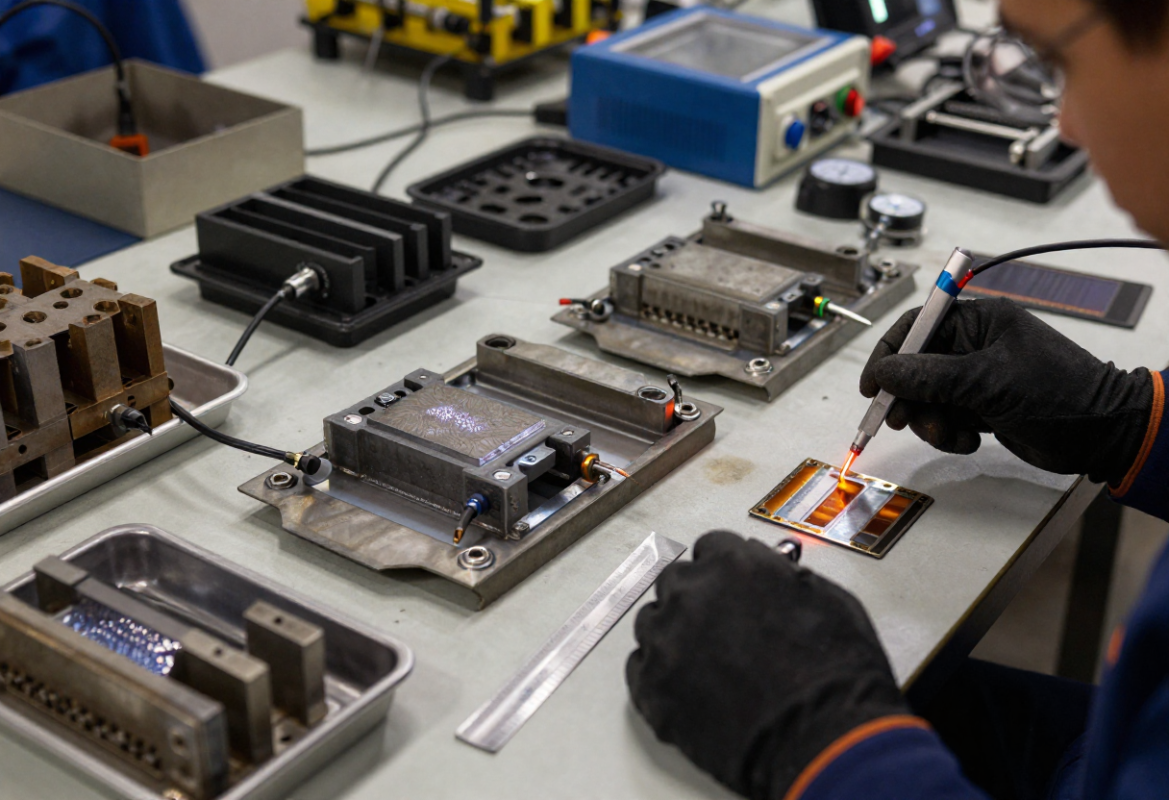
Inspection methods are selected based on criticality: visual, dye penetrant, ultrasonic testing (UT), phased array UT, radiography (X‑ray / CT), leak testing (helium/pressure decay) and mechanical testing. We combine surface and volumetric methods for comprehensive assurance.
Common NDT methods
- Visual & dye penetrant for surface discontinuities
- Ultrasonic (conventional & phased array) for volumetric defects
- X‑ray / CT for porosity mapping and internal features
- Helium leak and pressure decay for sealed assemblies
Thermal Management & Distortion Control
Minimizing distortion is essential for sealing faces and assemblies. Strategies: staged weld sequencing, back‑chill and heat sinks, active cooling, fixturing that permits symmetric heat removal, and pre/post‑heat treatments or stress relief as needed.
Techniques
- Use of sacrificial backing plates and heat spreaders
- Staged weld patterns to balance thermal input
- Pre‑heating or post‑weld tempering for certain alloys
- In‑process thermal monitoring using thermocouples or IR
Representative Projects
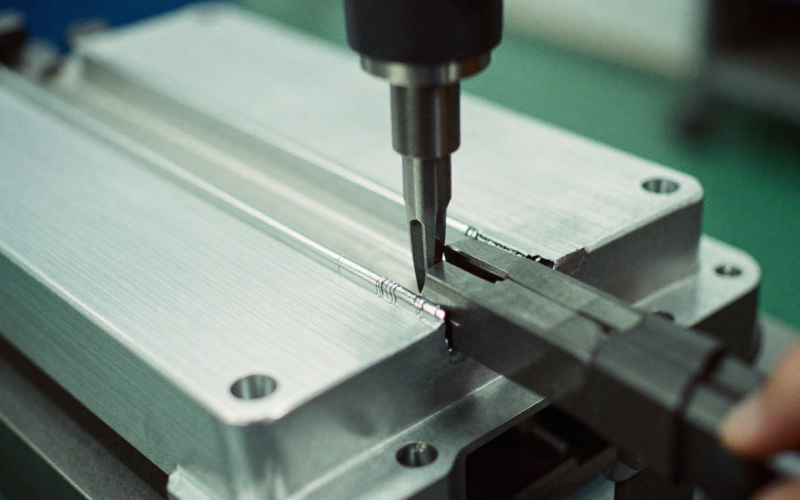
FSW Cold Plate Seams for EV Power Module
Custom FSW fixture and gantry for single‑sided sealing of aluminum cold plates — integrated force/torque sensing, active cooling and CMM verification with leak testing to validate seam integrity.
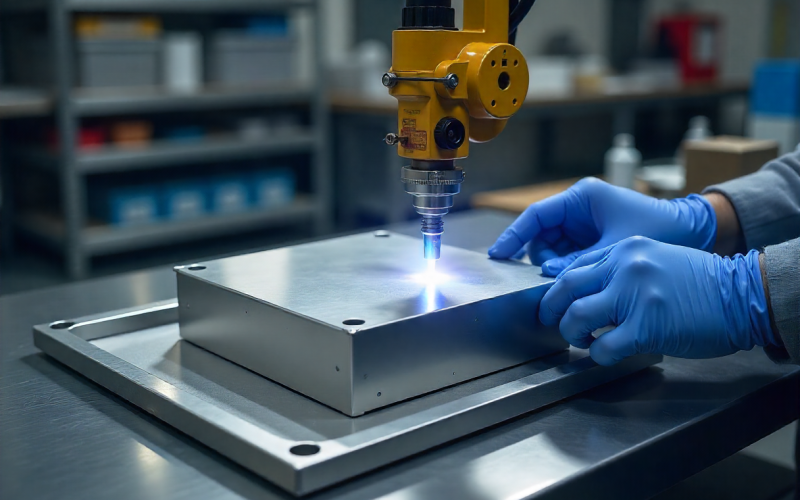
Laser Welded Stainless Enclosure
Robotic fiber‑laser welding with seam tracking for minimal HAZ and cosmetic finish, followed by passivation and leak validation for IP rating.
Frequently Asked Questions
Can you weld thin sheets without warpage?
Yes — laser welding, controlled TIG/MIG pulse settings, and balanced fixturing reduce heat input and distortion. We often use stitch patterns, backing bars, and pre/post fixture clamping to control warpage.
How do you achieve leak‑tight cold plate seams?
FSW is commonly used for leak‑tight aluminum seams. For fusion welding we use controlled joint prep, backing, process monitoring and helium/pressure decay leak testing to validate seam integrity.
Do you provide qualified welding procedure specifications (WPS)?
Yes — we develop and document WPS/PQR records, perform qualification testing and deliver FAI/PPAP packages and operator training for production run‑offs.
Can you automate weld inspection and acceptance?
Yes — we integrate in‑line sensors, vision checks, seam trackers and automated NDT gating to accept/reject parts during production and log per‑unit trace data to MES.
Start Your Welding Project
Upload assembly drawings, joint cross‑sections, materials and target volumes. We’ll recommend the optimal welding process, fixture concept, required inspections and an estimated lead time — typically within 24 business hours.