

Inventory & VMI Programs
📦 VMI at Customer Site 🌍 Regional Consignment
🪢 Hub & Spoke Stocking 🔄 Vendor Replenishment
Lower Working Capital • Higher Fill Rate • Faster Response
Tailored Inventory Programs
We design supply chain models—from VMI and Kanban to regional buffering—that fit your unique business rhythm. By auditing demand patterns and setting precise replenishment rules, we implement systems that optimize stock levels and ensure confident delivery.

Program Types
We tailor programs to business needs. Common approaches include VMI (supplier-managed inventory at customer or regional node), consignment stock (buyer-owned but supplier-held), kanban/JIT pull systems, safety stock optimization, and regional buffer warehouses.

How We Engage
We audit demand patterns and lead times, design replenishment rules and min/max thresholds, identify SKUs for VMI, implement systems for real-time visibility, and pilot programs before a full rollout.

Vendor Managed Inventory (VMI)
With VMI we operate replenishment on your behalf. We propose min/max, reorder points, safety stock and replenishment cadence. VMI reduces buyer inventory burden while keeping agreed service levels. Visibility tools provide daily on-hand, open orders and forecast reconciliation.
Replenishment Rules
Min/Max, reorder point, lead-time buffers, and forecast-based safety stock.
Reporting & Dashboards
Daily stock status, aging, turns, fill rate and suggested picks for production.
Commercial Models
Consignment, prepaid replenishment, or KPI‑tied service fees; we document reconciliation and ownership terms.`
Kanban & Just‑In‑Time (JIT)

Kanban Sizing
Calculate kanban card counts from demand rate, lead time and safety factor to sustain continuous flow.

Electronic Kanban
Integrate E-Kanban with supplier portals or EDI for automated replenishment and tracking.
Safety Stock & Forecasting
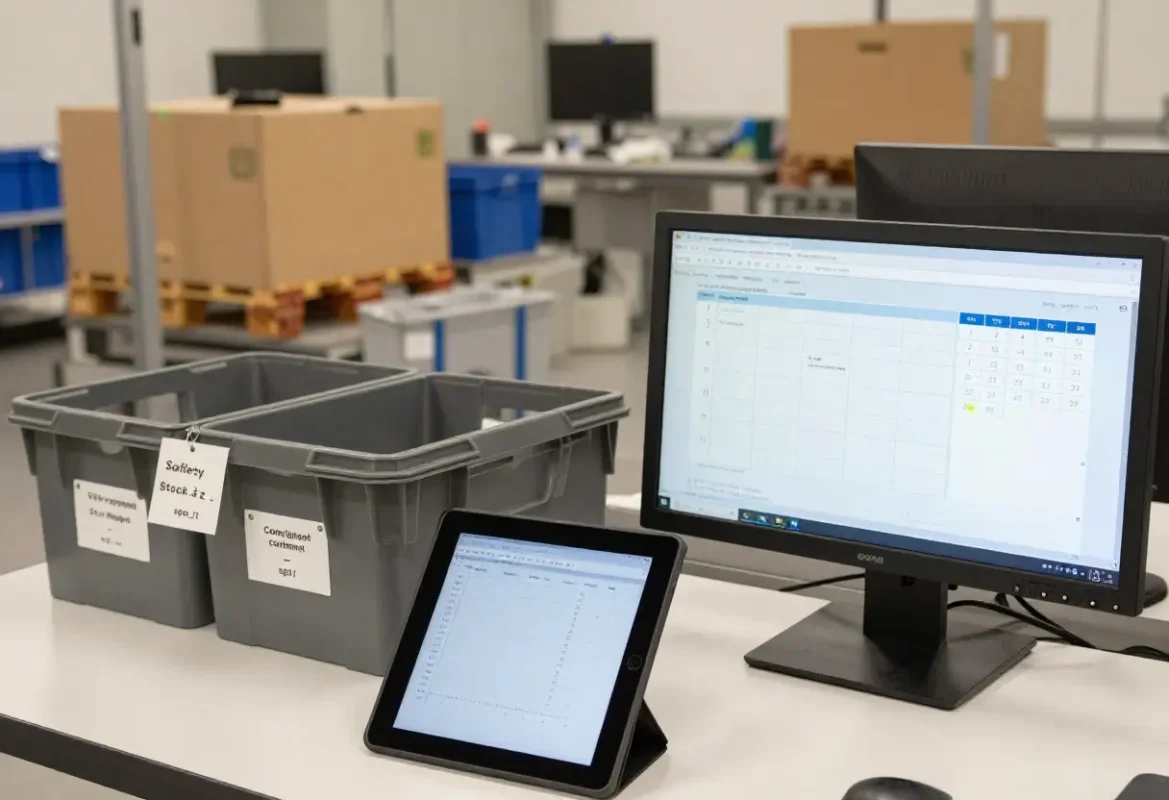
We model safety stock using lead-time variability, service level targets and demand volatility. Approaches include statistical safety stock (z*σLT) and scenario-based buffers for seasonality and supplier risk.
Replenishment Strategies
Options include periodic review (S, T), continuous review (Q, R), consignment triggers and daily VMI replenishment. We recommend the optimal method per SKU cluster (A/B/C) and value-impact tradeoffs.
Program KPIs

Fill Rate
Target > 98% for critical SKUs

Stock Turn
Optimize to reduce days on hand without risking outages

Days of Supply
Balanced to forecast accuracy and lead-time

Inventory Accuracy
Cycle count targets > 99% for VMI-managed parts

U.S. Dallas Warehouse & Regional Buffering

Services
Receiving, inspection, kitting, pick/pack, returns, repairs, and cross-dock. Integration with VMI for regional replenishment.

SLA & Reporting
Order lead-time, fill-rate, damage rate, inventory aging and reconciliation cadence are defined in the SLA and portal dashboards.
| Program Type | Ownership | Benefits | Risks |
|---|---|---|---|
| VMI (Supplier-managed on site) | Supplier owns replenishment and stock operations | Lower buyer inventory, higher service | Requires integration & trust, robust reconciliation |
| Consignment (Regional) | Supplier holds stock; buyer pays on usage | Minimal buyer capital outlay | Complex ownership and accounting |
| Kanban / JIT | Shared ownership; pull-based triggers | Smooth assembly flow, low on-hand | Sensitive to supplier reliability |
| Item | Purpose |
|---|---|
| SKU segmentation (ABC) | Prioritize which SKUs get VMI/consignment vs PO replenishment |
| Forecast & lead-time data | Base safety stock and replenishment rules |
| Agreement on ownership & invoicing | Define consignment billing, VMI triggers, and reconciliation cadence |
| Portal & EDI connectivity | Real-time stock and order visibility for VMI |
| SLA & KPI targets | Establish fill rate, damage, lead time and reconciliation SLAs. |